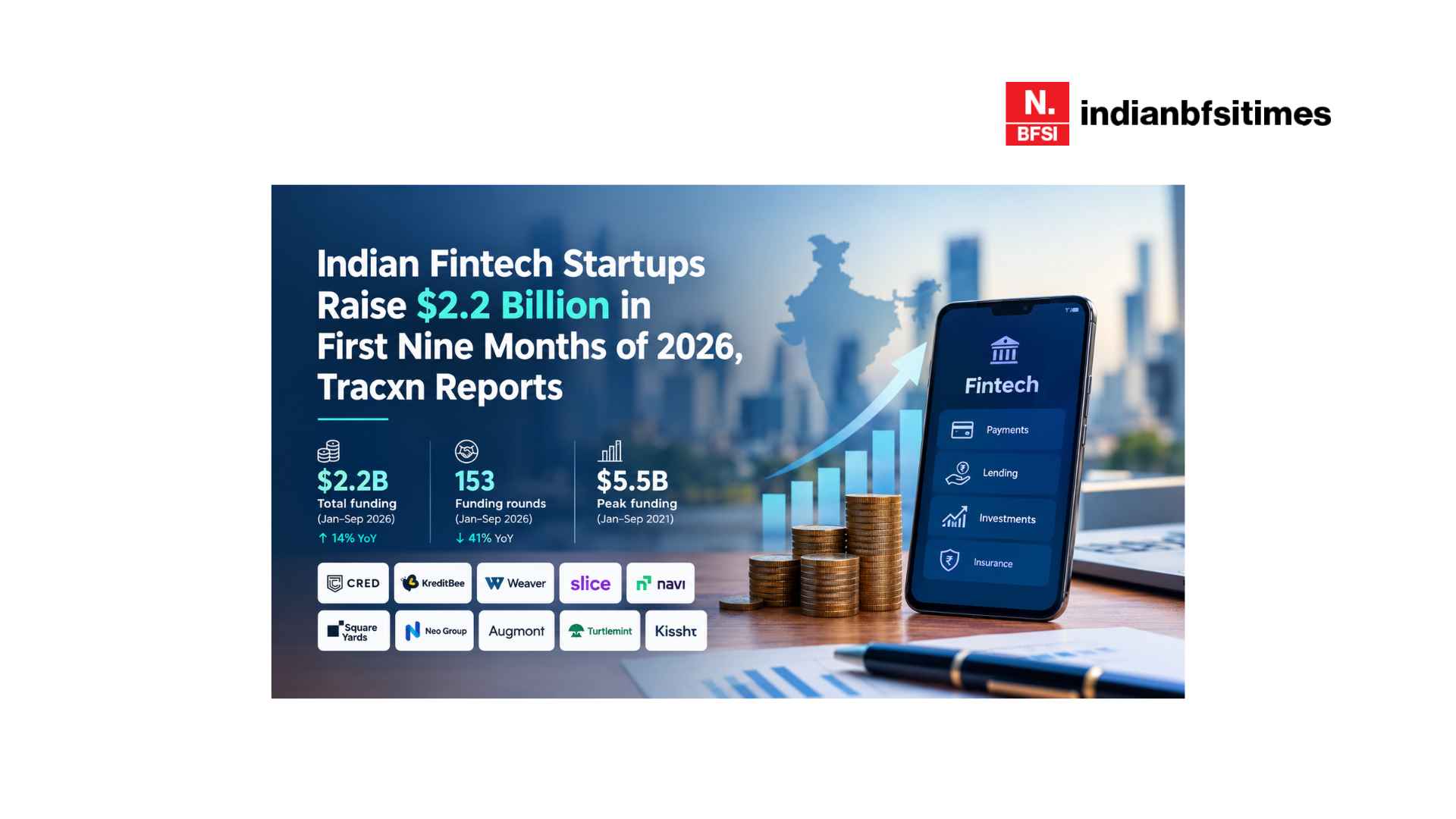
India’s fintech sector raised $2.2 billion in funding between January and September 2026, marking a 14% increase from the $1.9 billion raised during the same period last year. However, the number of funding rounds fell sharply, dropping 41% year-on-year, as investors concentrated larger amounts of capital in a smaller number of companies, according to a report by data intelligence platform Tracxn.
Fintech companies closed 153 funding rounds in the first nine months of 2026, compared with 260 rounds during the corresponding period in 2025. Despite the increase in total funding, the sector remains well below its previous peak. The amount raised during the period was around 40% of the $5.5 billion secured in the first nine months of 2021.
Five Large Deals Account for Nearly Half of Total Funding
Five funding rounds of $100 million or more contributed approximately $1.1 billion, accounting for nearly half of the sector’s total funding during the period.
CRED’s $540 million Series H round in June was the largest deal and alone accounted for around a quarter of all fintech funding. The round was backed by Meta.
The other major deals were KreditBee’s $220 million Series E round in April, Weaver’s $103 million Series B round in March, Slice’s $100 million Series D round in September and Navi’s $100 million Series C round in August.
These large transactions played a significant role in supporting overall funding growth, even as the number of deals declined across the sector.
Late-Stage Funding Nearly Doubles
Late-stage funding was the only funding category to record growth during the first nine months of 2026. It includes Series C and later rounds, private equity investments and pre-IPO funding.
Capital raised at this stage nearly doubled to $1.5 billion from $751 million a year earlier. The number of late-stage deals, however, declined to 25 from 30. Late-stage investments accounted for 67% of the total capital raised by Indian fintech companies during the period.
Early-stage funding continued to face pressure. Funding through Series A and Series B rounds fell 33% to $668 million across 52 rounds, compared with $1 billion raised through 82 rounds in the same period of 2025.
Seed-stage funding saw a steeper decline. Startups raised $73.8 million across 76 rounds, down 57% from $173 million across 148 rounds a year earlier.
The figures indicate that investors continued to support established companies with larger capital requirements, while smaller and younger startups faced a more challenging fundraising environment.
Fewer Startups Attract First-Time Investments
The number of fintech companies raising funds for the first time nearly halved to 30 during January-September 2026, compared with 59 in the same period last year.
The investor base also narrowed. The number of existing investors active in the sector declined to 125 from 192, while first-time investors fell to 33 from 48, according to Tracxn.
The decline across these measures points to a more selective funding environment, with fewer investors and companies participating in financing activity.
Digital Lending Leads Funding by Segment
Digital lending attracted the highest funding among fintech segments, securing $809 million during the first nine months of 2026. Payments followed with $776 million, while investment technology companies raised $450 million.
Bengaluru strengthened its position as the leading destination for fintech investments. The city accounted for 62% of total funding, or approximately $1.4 billion, up from 52% a year earlier.
Mumbai ranked second with a 24% share of fintech funding, followed by Gurugram at 7%.
Three New Unicorns Emerge
India’s fintech ecosystem added three new unicorns during the period: Square Yards, KreditBee and Neo Group. A unicorn is a privately held startup valued at $1 billion or more. The sector had produced two new unicorns during the corresponding period last year.
The period also saw three fintech-related initial public offerings (IPOs), compared with two in the first nine months of 2025.
Augmont led the IPO activity, recording a market capitalisation of $757 million at its August listing. Turtlemint followed with a market capitalisation of $471 million at its June IPO, while Kissht recorded $305 million at its May listing.
Fintech Acquisitions Decline 45%
Acquisition activity slowed during the period, with the number of deals falling 45% to 11 from 20 in the first nine months of 2025.
The largest transaction was Indiabulls Group’s $110 million acquisition of Fintech Cloud. Other notable deals included Oxyzo’s acquisition of GoldenPi for $4.4 million and Choice’s purchase of Fintoo for $1.1 million.
Funding Growth Remains Concentrated in Larger Deals
India’s fintech funding figures for January-September 2026 reflect a market in which overall investment has grown, but capital is increasingly concentrated in a limited number of large transactions and established businesses.
While late-stage funding and major deals supported the rise in total capital raised, early-stage and seed funding declined, alongside the number of funding rounds, first-time fundraisers and active investors. With digital lending, payments and investment technology leading by segment, the coming months will show whether the funding recovery broadens to include more startups or remains driven primarily by larger deals.
-By Shivani Solanki